

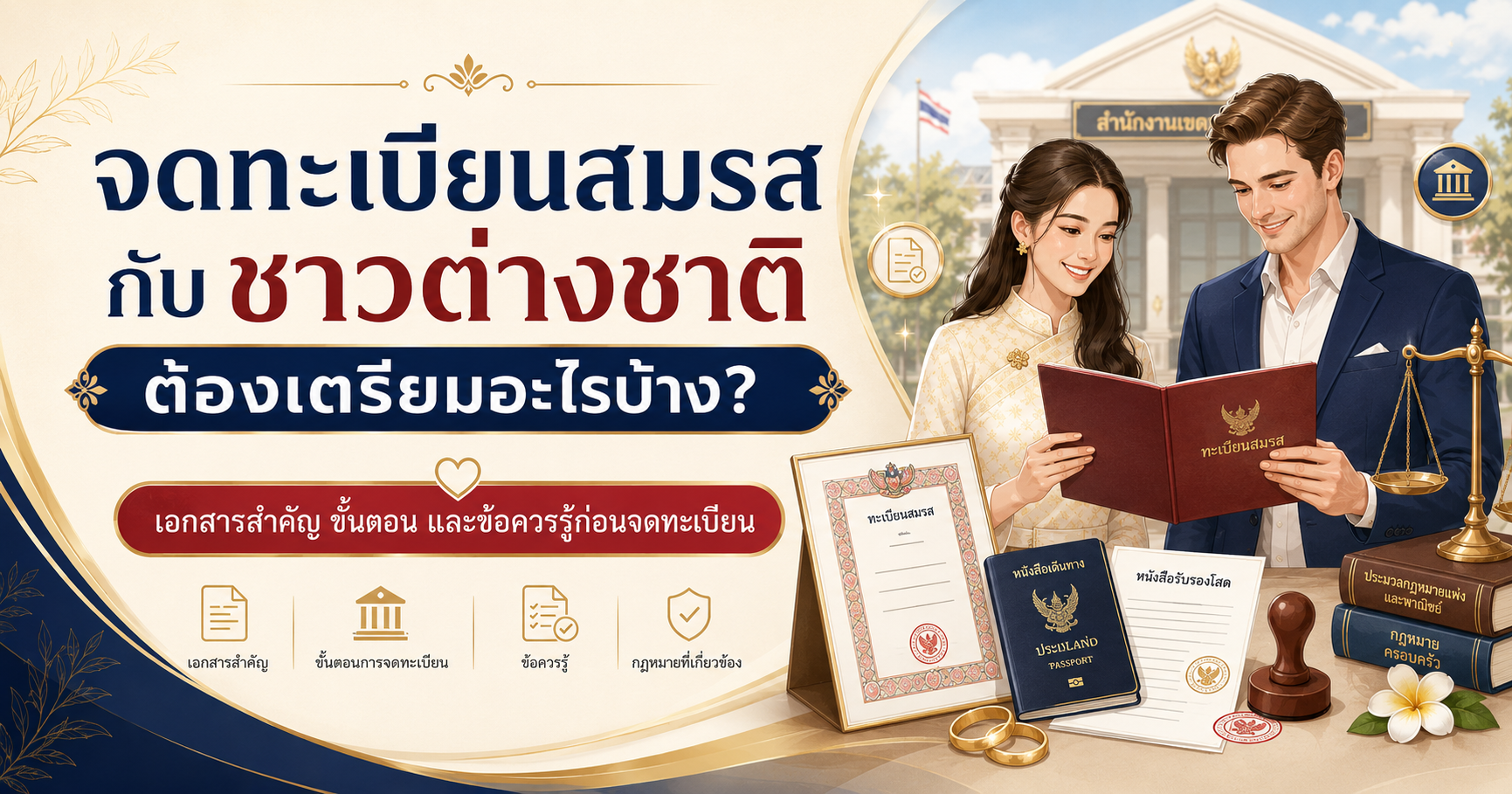
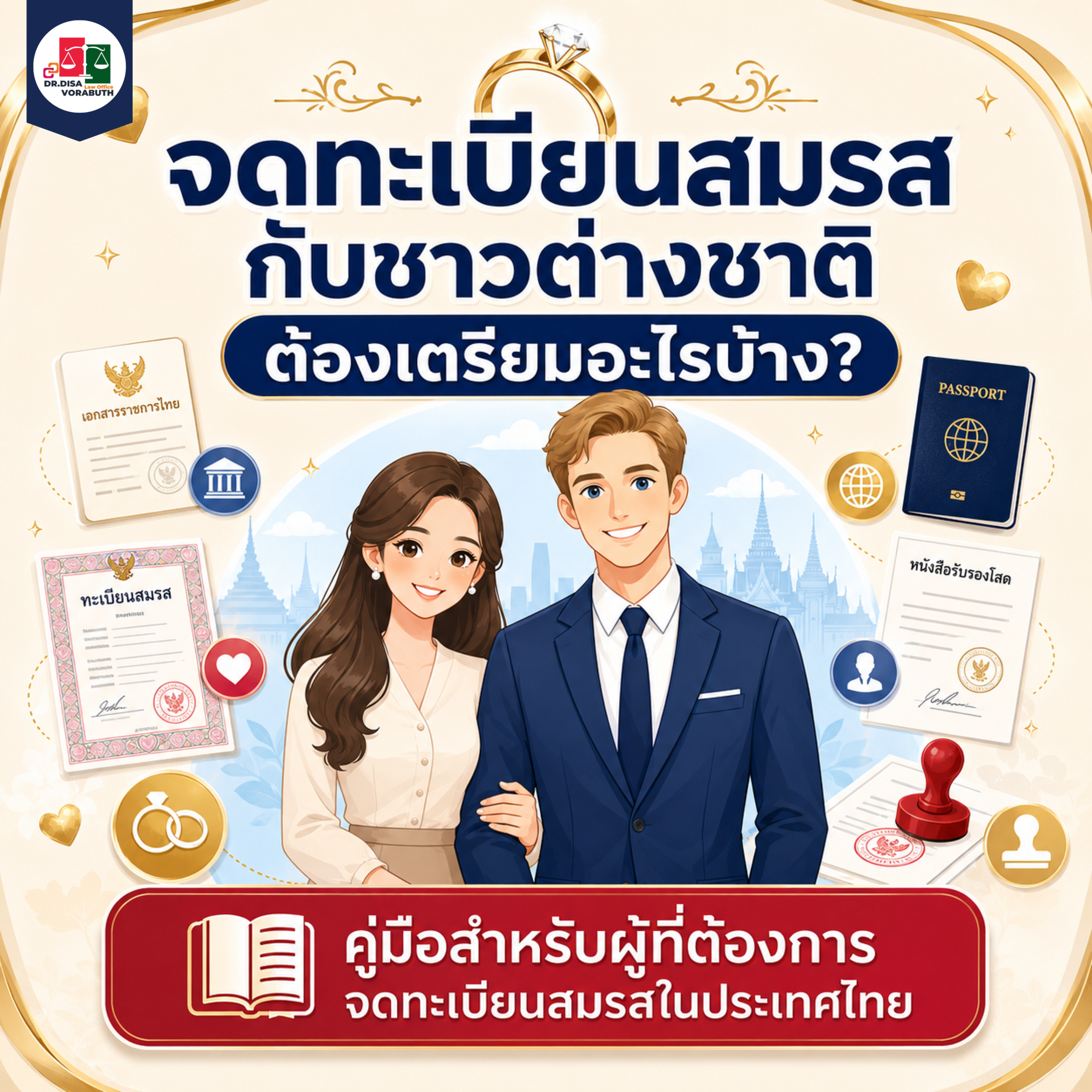
Marriage Registration with a Foreigner: What Documents Should You Prepare?
A Guide for Those Who Wish to Register Their Marriage in Thailand
Marriage registration with a foreigner in Thailand is a matter of interest for many couples, especially where one party is Thai and the other party is a foreign national, and they wish to have their relationship legally recognized.
Although marriage registration may seem like a general document-based procedure, cases involving a foreign national often involve more details than marriage registration between Thai nationals. These may include documents from the foreign national’s home country, a certificate of single status or marital status, certification of documents by the embassy, translation of documents into Thai, and legalization by the Department of Consular Affairs.
This article explains who is eligible to register a marriage, what documents are required, what the process involves, and what important points should be considered before registering a marriage with a foreigner.
Can You Register a Marriage with a Foreigner in Thailand?
Yes, it is possible, provided that both parties meet the qualifications required under Thai law and prepare all documents required by the registrar.
In general, couples may apply for marriage registration at a district office, district administrative office, or any authority authorized to register marriages. If either party is a foreign national, documents confirming identity, marital status, and foreign documents that have been properly certified must be provided.
According to information from the Bangkok Metropolitan Administration, where either one or both applicants for marriage registration are foreign nationals, the application may be submitted to the registrar at the registration division of any district office. The foreign national must also provide a certificate issued by their embassy or consulate for the purpose of marriage registration.
Who Is Eligible to Register a Marriage?
Marriage registration must comply with the requirements under Thai law. The key principle is that both parties must meet the legal qualifications and must not fall under any legal prohibitions.
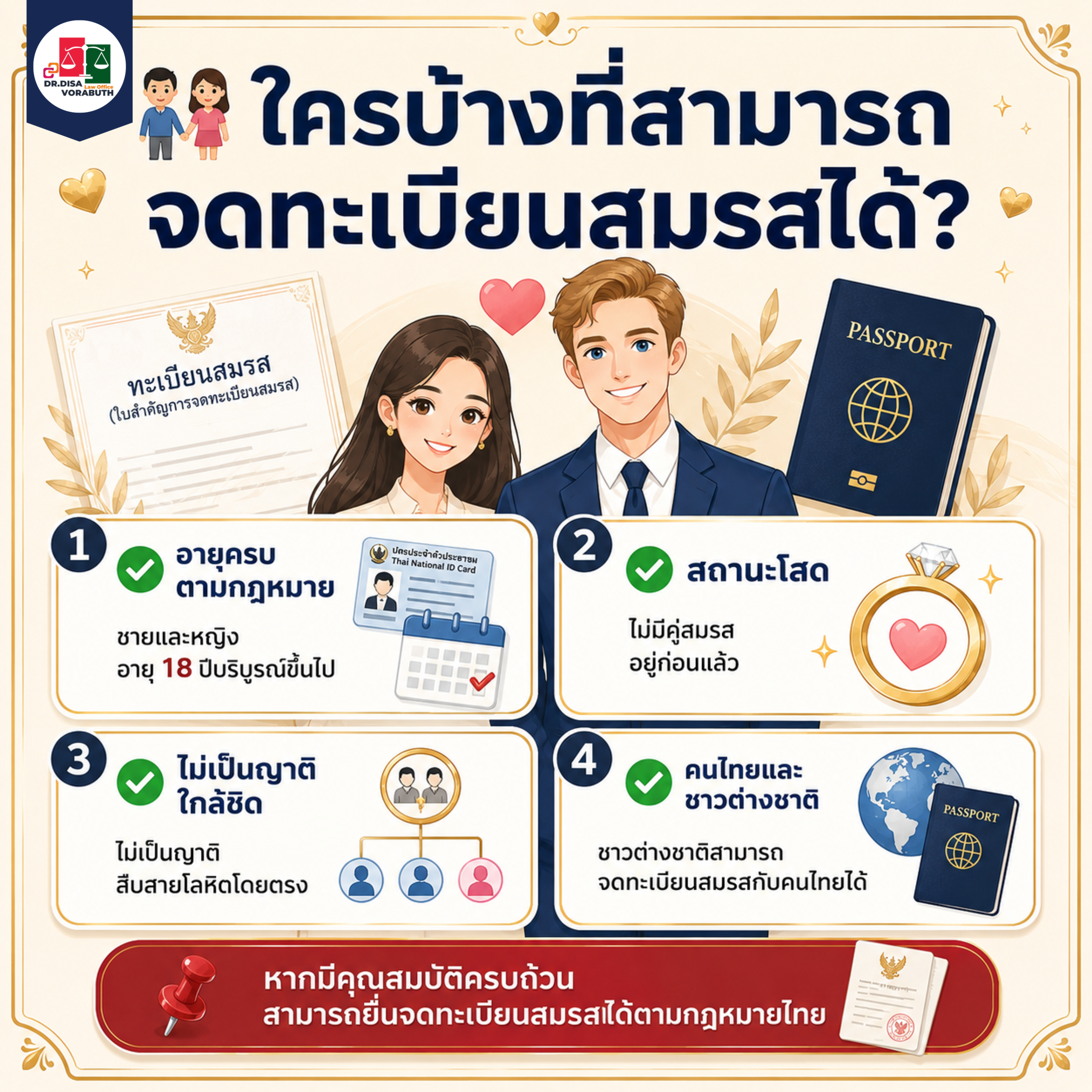
1. Both Parties Must Be of Legal Age
At present, the law provides that marriage may be registered when both parties are at least 18 years old. However, if there is an appropriate reason, the court may allow marriage before that age in accordance with the law.
In practice, if either party is still a minor, consent from a legally authorized person, such as a parent or guardian, may be required, depending on the circumstances. Therefore, it is advisable to check with the district office or district administrative office before proceeding.
Example
A Thai woman aged 25 wishes to register her marriage with a foreign man aged 30. Both parties are of legal age, neither party is already married, and they are not close relatives. In this case, they may proceed with marriage registration if all required documents are complete.
2. Neither Party Must Already Have a Spouse
A person who wishes to register a marriage must be single, divorced, or widowed. A person cannot register a new marriage while they still have a legal spouse.
Therefore, an important document for the foreign party is a certificate of single status or a document confirming that they are legally eligible to marry under the law of their own country. In general, this document must be issued or certified by the relevant authority and must go through the process required by the Thai authorities.
3. The Parties Must Not Be Close Relatives Prohibited by Law
The prospective spouses must not be direct blood relatives, such as parent and child, grandparent and grandchild, or siblings with the same father and mother, or siblings with the same father or the same mother.
4. Thai Nationals and Foreign Nationals Can Register Marriage Together
A Thai national may legally register a marriage with a foreign national under Thai law, provided that both parties meet all legal qualifications and prepare the required documents according to the relevant procedures.
For documents of the foreign party, they usually need to be processed through the embassy, translated into Thai, and legalized by the Department of Consular Affairs before being submitted to the registrar.
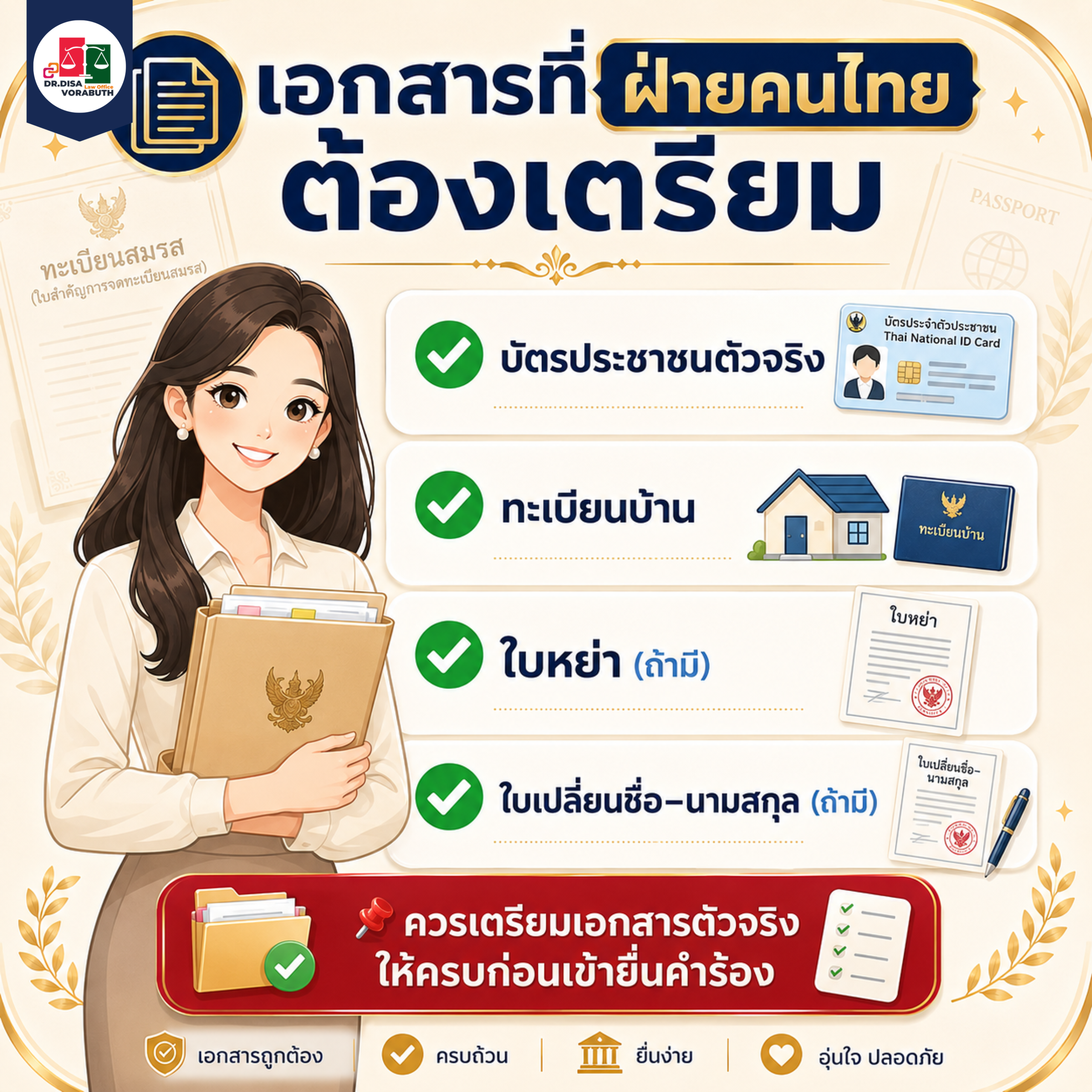
Documents to Be Prepared by the Thai Partner
The documents required from the Thai partner are generally less complicated than those required from the foreign partner. However, the original documents should be prepared completely so that the registrar can verify them.
1. Original Thai National ID Card
This is used to verify the identity of the Thai partner. The ID card should be checked to ensure that it has not expired and that the name, surname, and identification number are correct.
2. Household Registration
The household registration is used to verify personal information, domicile, and other details relevant to the marriage registration.
3. Divorce Certificate, If Previously Married
If the Thai partner has previously registered a marriage and is now divorced, a divorce certificate or other document showing that the current marital status allows remarriage should be prepared.
Example
A Thai woman who was previously married and has already registered a divorce wishes to marry a foreign national. In this case, she should prepare her original ID card, household registration, and divorce certificate so that the registrar can verify her marital status before registering the new marriage.
4. Name or Surname Change Certificate, If Any
If the Thai partner has previously changed their name or surname, or if the information does not match other documents, a name or surname change certificate should also be prepared to prevent problems caused by inconsistent documents.
Documents to Be Prepared by the Foreign Partner
Documents for the foreign partner should be prepared in advance because each country has different forms and procedures for issuing documents. Some countries require documents to be obtained from the home country, while others may allow documents to be obtained from their embassy in Thailand.
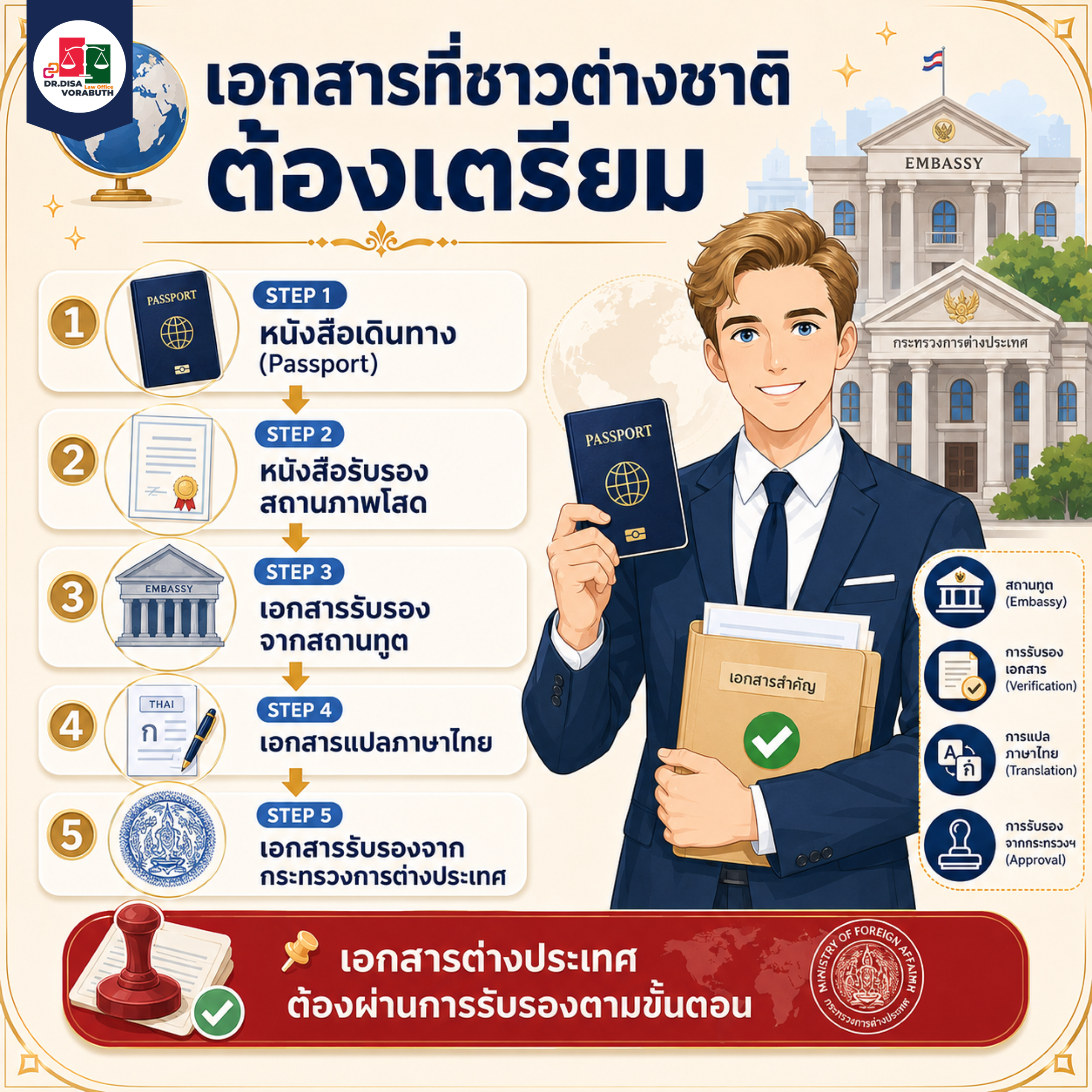
1. Passport
The foreign partner must use their original passport to verify their identity, nationality, and travel information for entering Thailand.
2. Certificate of Single Status or Certificate of Legal Capacity to Marry
This is often the most important document for the foreign partner. It is used to confirm that the foreign partner does not already have a spouse or has a status that allows them to legally register a marriage.
The Department of Consular Affairs states that, in the case of marriage registration with a foreign national under Thai law, important documents for the foreign party may include a certificate of single status issued by the authority of their country, a passport, and two witnesses. If the applicant is under the legal age, parental consent may also be required.
3. Certification from the Embassy or Consulate
In general, the certificate of single status or certificate of legal capacity to marry of the foreign partner must be certified by the embassy or consulate of that country in Thailand, or by the relevant authority in the foreign partner’s home country according to the applicable procedures.
4. Thai Translation of Foreign Documents
Foreign documents that are not in Thai usually need to be translated into Thai before they can be used for marriage registration. The translation should be accurate and complete. If details such as name, date of birth, nationality, or marital status do not match, the registrar may refuse to register the marriage.
5. Legalization by the Department of Consular Affairs, Ministry of Foreign Affairs
Foreign documents and their Thai translations generally need to be legalized by the Department of Consular Affairs, Ministry of Foreign Affairs, before being submitted to the district office or district administrative office.
The Department of Consular Affairs provides legalization services for documents relating to marriage registration with foreigners and the recording of family status registration, or Kor Ror 22, with information updated on 22 January 2025.
Steps for Registering Marriage with a Foreigner in Thailand
The process may vary depending on the nationality of the foreign partner and the practices of the relevant authorities. However, the general steps can be summarized as follows:
Step 1: Check the Qualifications and Age of Both Parties
Before preparing the documents, both parties should check whether they meet the legal requirements, such as being of legal age, not already having a spouse, not being close relatives, and not being subject to any legal prohibition on marriage.
Step 2: Check the Requirements of the Embassy
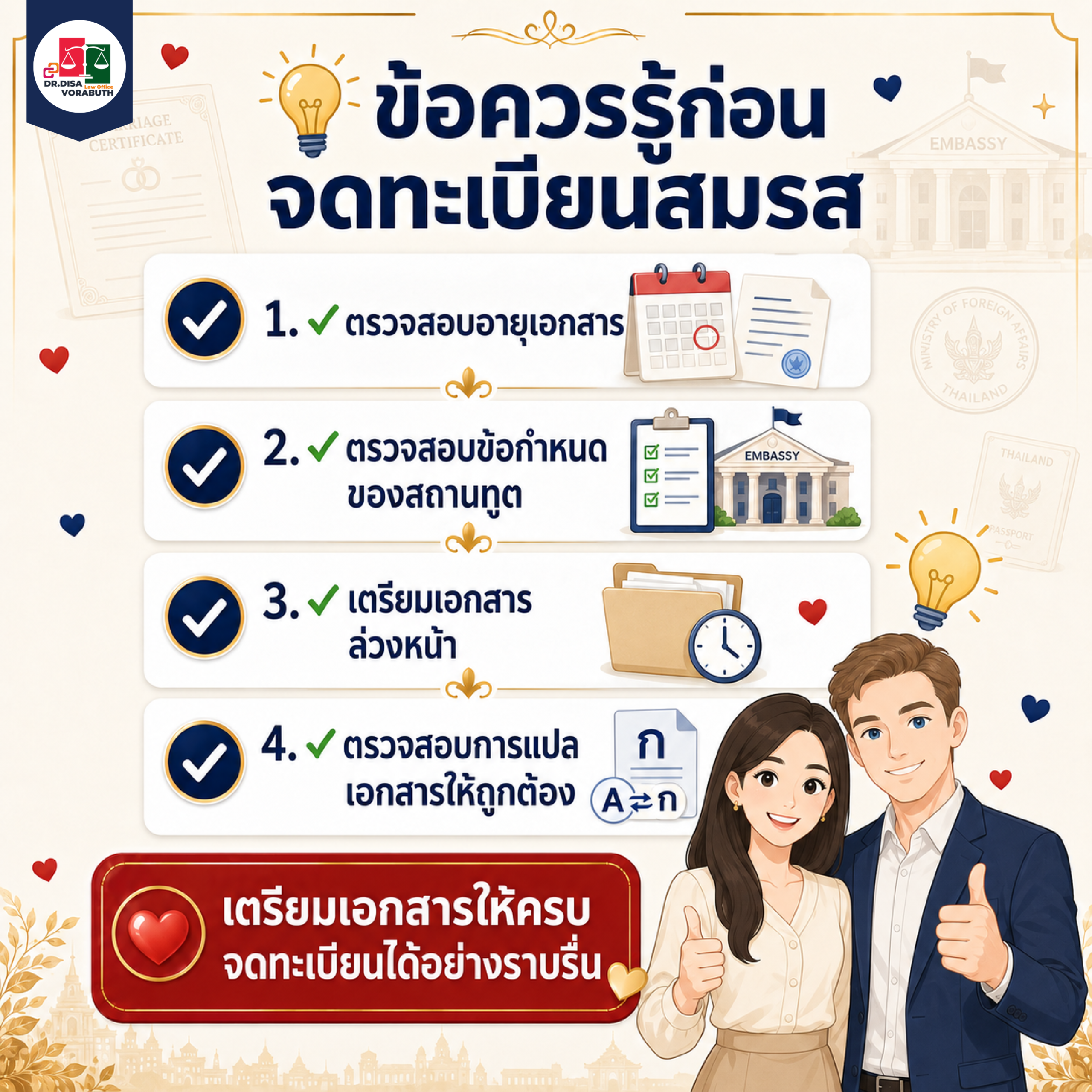
The foreign partner should contact their embassy or consulate in Thailand to ask what documents are required to issue a certificate of single status or a certificate of legal capacity to marry.
Each country may require different documents. For example, some countries may require a birth certificate, while others may require household registration, proof of domicile, an affidavit, or a marital status certificate issued by the home country.
Example
A foreign man wishes to register his marriage with a Thai woman. He contacts his embassy in Thailand and is informed that he must prepare his passport, a certificate of single status from his home country, and divorce documents if he was previously married. Therefore, he should prepare these documents before visiting the embassy.
Step 3: Obtain a Certificate of Single Status or Certification from the Embassy
Once the documents are complete, the foreign partner submits an application to their embassy or consulate to request a certificate of single status or a certificate confirming that they are legally able to marry.
Step 4: Translate the Documents into Thai
After receiving the documents from the embassy or from abroad, the documents must be translated into Thai. It is advisable to use a translator who is experienced with official documents to ensure that the information is complete and consistent with the original documents.
Step 5: Legalize the Documents at the Department of Consular Affairs
After the documents have been translated, the original documents and the Thai translations must be submitted for legalization at the Department of Consular Affairs, Ministry of Foreign Affairs, so that they can be used with Thai government authorities.
The Department of Consular Affairs provides guidance on foreign documents. If a certificate of single status from the home country is used, the document must be certified by the Ministry of Foreign Affairs of the home country in order to support marriage registration with a Thai national at the Royal Thai Embassy or Royal Thai Consulate-General in that country.
Step 6: Register the Marriage at a District Office or District Administrative Office
Once all documents are complete, both parties must appear before the registrar to submit the marriage registration application. All original documents should be brought, together with witnesses as required by the relevant authority.
It is advisable to contact the district office or district administrative office in advance to check whether they accept marriage registration involving a foreign national, whether an appointment is required, whether an interpreter or additional witnesses are needed, and whether there are any specific local requirements.
Important Points to Know Before Registering Marriage with a Foreigner
1. Check the Validity Period of the Documents
Some documents, such as a certificate of single status or a certificate issued by an embassy, may have a limited validity period. If the document was issued too long ago, the district office or district administrative office may refuse to accept it. Therefore, it is advisable to check the validity period of the documents with the relevant authorities in advance.
2. Check That Names, Surnames, and Dates of Birth Match
A common issue is inconsistent spelling of names across the passport, embassy documents, translations, and certified documents. If the information does not match, the documents may need to be corrected or retranslated, which can cause delays.
Example
The name in the passport is written as “Jonathan Smith,” but the Thai translation spells it as “โจนาธาน สมิธ,” while another document translates it as “โจนาทาน สมิท.” In this case, the officer may request that the translation be corrected so that the information is consistent before accepting the marriage registration.
3. Foreign Documents Must Be Properly Certified
Foreign documents should not be submitted directly if they have not been properly certified or translated as required. Otherwise, the registrar may not be able to use those documents for the marriage registration.
4. Check the Requirements of Each Embassy
Each embassy may have different procedures. Some embassies require an appointment in advance, some may take several days to issue documents, and some may require documents issued only from the foreign partner’s home country. Therefore, the requirements should be checked before making travel plans.
5. Marriage Registration Has Legal Effects
Once the marriage is legally registered, the spouses will have legal rights and duties, such as the duty to support each other, rights relating to property during marriage, inheritance rights, the right to make certain decisions on behalf of each other, and other legal consequences.
Therefore, before registering the marriage, couples should clearly understand matters such as personal property, marital property, debts, authority to manage property, and future legal rights.
After Registering Marriage with a Foreigner, Is It Necessary to Record the Marriage in the Spouse’s Country?
If the marriage has been registered in Thailand and the couple wishes for the foreign spouse’s country to recognize or acknowledge the marital status, it may be necessary to have the Thai marriage registration documents translated, legalized, and submitted to the embassy or relevant authority of that country.
This process depends on the laws and procedures of each country. For example, some countries require the marriage to be recorded in their civil registration system, while others may require translated documents legalized by the Department of Consular Affairs first.
Example
A Thai woman registers her marriage with a foreign man at a district office in Thailand. After that, the foreign spouse needs to use the Thai marriage certificate to apply for a spouse visa in his country. In this case, the marriage certificate may need to be translated into English and legalized according to the procedures required by the embassy.
If the Marriage Was Registered Abroad, What Should Be Done in Thailand?
If a Thai national registers a marriage abroad and wishes for that marital status to appear in the Thai civil registration system, it is generally necessary to record the family status registration, known as Kor Ror 22, in Thailand. This usually requires the foreign marriage documents to be properly legalized and translated according to the relevant procedures.
The Department of Consular Affairs provides information on document legalization for marriage registration with foreigners and the recording of family status registration, or Kor Ror 22. This reflects that if a marriage is registered abroad and the documents are to be used in Thailand, the legalization process should be completed properly before submitting the documents to the Thai authorities.
Examples of Marriage Registration with a Foreigner
Example 1: A Foreign National Is in Thailand and Wishes to Register the Marriage at a District Office
A Thai woman wishes to register her marriage with a foreign man who is staying in Thailand. The foreign partner must contact his embassy to obtain a certificate of single status. He must then have the document translated into Thai, legalized by the Department of Consular Affairs, and submit all required documents together with the Thai partner at the district office for marriage registration.
Example 2: The Foreign Partner Was Previously Married
A foreign man who was previously married and divorced wishes to marry a Thai woman. In this case, in addition to his passport and marital status certificate, he may need to prepare divorce documents from his home country or documents certified by his embassy confirming that his current status allows him to marry. These documents must also be translated and legalized according to the required procedures.
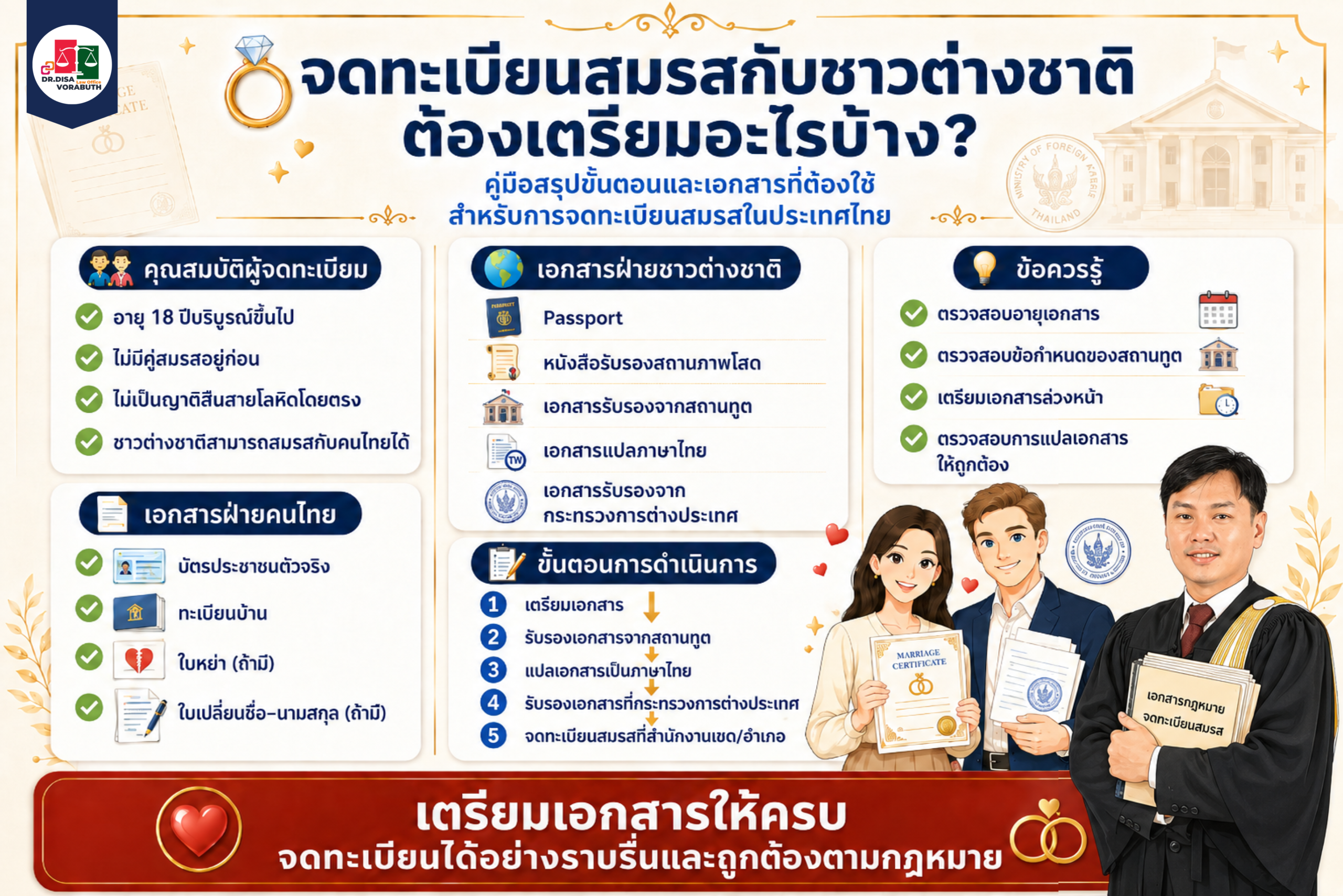
Marriage registration with a foreigner in Thailand is possible if both parties meet the legal qualifications and prepare the required documents correctly. The Thai partner generally needs to prepare a Thai national ID card, household registration, divorce certificate, or name change certificate, if any. The foreign partner must prepare a passport, certificate of single status, embassy certification, Thai translations, and documents legalized by the Department of Consular Affairs.
The key steps include checking the embassy’s requirements, obtaining a marital status certificate, translating the documents, legalizing the documents with the Department of Consular Affairs, and submitting the documents for marriage registration at a district office or district administrative office.
Since the document requirements of each country may differ, couples should plan ahead, check the validity period of the documents, and consult a professional if they have any questions. This helps ensure that the marriage registration process proceeds smoothly and legally.
 Tel : 062-652-4259 (Attorney Dr. Ning)
 LINE ID : @disavorabuthlaw
 For more information, please follow us on
ด้วยประสบการณ์ด้านกฎหมายที่สั่งสมมาตั้งแต่ปี พ.ศ. 2555 เราคือผู้เชี่ยวชาญที่คุณวางใจได้ในทุกปัญหาทางกฎหมาย ไม่ว่าจะเป็น กฎหมายแพ่งและพาณิชย์ ที่ครอบคลุมสัญญาต่างๆ การฟ้องร้อง และการดำเนินคดี หรือกฎหมายแรงงาน ที่ช่วยให้ธุรกิจของคุณหลีกเลี่ยงข้อพิพาท นอกจากนี้ เรายังเชี่ยวชาญใน กฎหมายครอบครัว กฎหมายมรดก กฎหมายคุ้มครองผู้บริโภค กฎหมายทรัพย์สินทางปัญญา กฎหมายอาญา และกฎหมายอื่นๆ นอกจากนี้ เรายังให้บริการให้คำปรึกษากฎหมายและบริการจดทะเบียนที่ครอบคลุมครบวงจรทั้งในกรุงเทพฯ และนครราชสีมา
ด้วยประสบการณ์ด้านกฎหมายที่สั่งสมมาตั้งแต่ปี พ.ศ. 2555 เราคือผู้เชี่ยวชาญที่คุณวางใจได้ในทุกปัญหาทางกฎหมาย ไม่ว่าจะเป็น กฎหมายแพ่งและพาณิชย์ ที่ครอบคลุมสัญญาต่างๆ การฟ้องร้อง และการดำเนินคดี หรือกฎหมายแรงงาน ที่ช่วยให้ธุรกิจของคุณหลีกเลี่ยงข้อพิพาท นอกจากนี้ เรายังเชี่ยวชาญใน กฎหมายครอบครัว กฎหมายมรดก กฎหมายคุ้มครองผู้บริโภค กฎหมายทรัพย์สินทางปัญญา กฎหมายอาญา และกฎหมายอื่นๆ นอกจากนี้ เรายังให้บริการให้คำปรึกษากฎหมายและบริการจดทะเบียนที่ครอบคลุมครบวงจรทั้งในกรุงเทพฯ และนครราชสีมา