

Getting Divorced in Thailand: What You Need to Know and What Steps to Take
Divorce is a sensitive matter involving relationships, family, property, and children. Many people misunderstand that if they “want a divorce,” they can immediately file a case with the court. However, under Thai law, divorce is subject to certain legal requirements, especially where the other spouse does not consent to the divorce.
A person who wishes to file for divorce must have a legally recognized ground for divorce and must provide supporting evidence sufficient for the court to believe that such ground actually exists.
This article explains the types of divorce in Thailand, the legal grounds for divorce, the divorce filing process, the issues considered by the court, and practical examples to make the topic easier to understand.
How Many Types of Divorce Are There in Thailand?
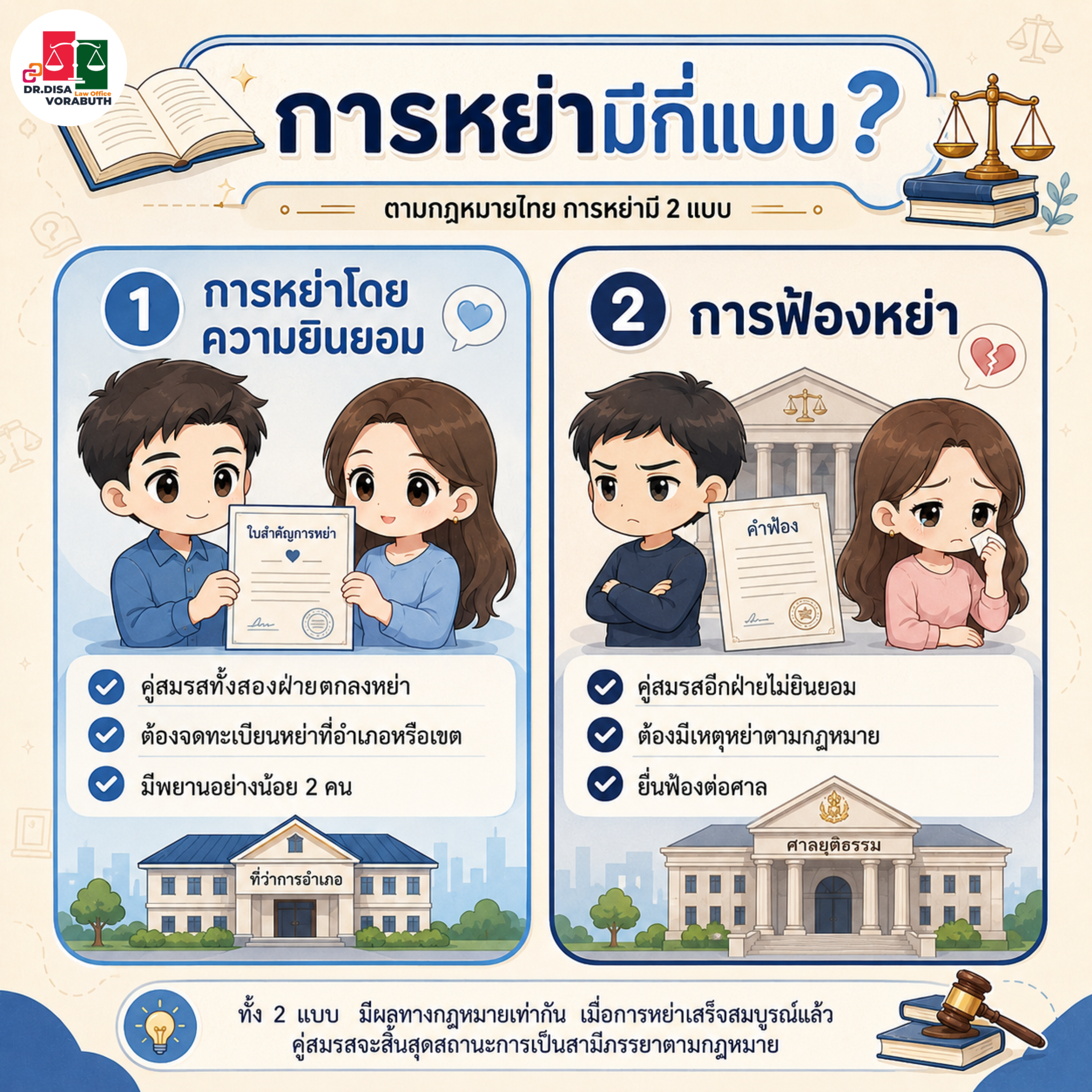
Under Thai law, divorce can generally be divided into two main types: divorce by mutual consent and divorce by court judgment.
Section 1514 of the Thai Civil and Commercial Code provides that divorce may be effected either by mutual consent of both spouses or by a judgment of the court. Divorce by mutual consent must be made in writing and signed by at least two witnesses.
1. Divorce by Mutual Consent
Divorce by mutual consent applies when both spouses agree to divorce and are able to reach an agreement on important matters such as property, debts, children, child support, or other relevant conditions.
In general, the spouses may register their divorce at the district office or district administrative office. However, it is advisable to clearly prepare a written agreement in advance, such as who will have custody of the child, who will be responsible for child-related expenses, which property belongs to whom, and who will be responsible for any debts.
Example
Mr. A and Ms. B agree to divorce. They have one child and one car. They agree that the child will live with Ms. B, Mr. A will pay child support of THB 8,000 per month, and Mr. A will continue to own the car.
In this case, the agreement should be clearly made in writing before registering the divorce.
2. Divorce by Court Proceedings
Divorce by court proceedings applies where one spouse wishes to divorce but the other spouse does not consent, or where both spouses agree to separate but cannot reach an agreement on important matters such as children, property, child support, or debts. In such cases, the spouse who wishes to divorce must file a lawsuit with the court.
However, filing for divorce is not simply based on “falling out of love” or “being unable to live together.” There must be a legal ground for divorce as prescribed by law, such as adultery, physical
What Are the Legal Grounds for Divorce under Thai Law?
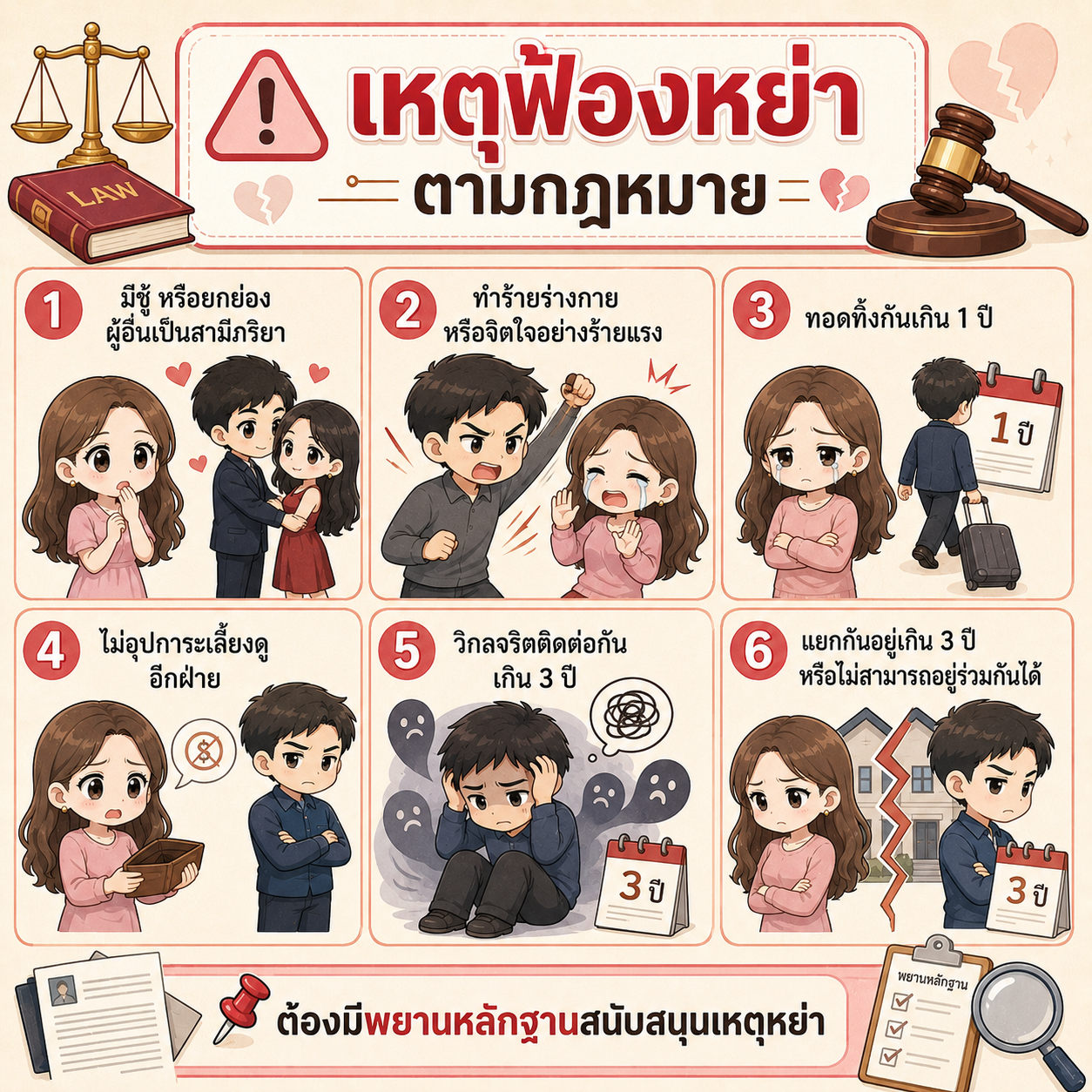
The legal grounds for divorce are provided under Section 1516 of the Thai Civil and Commercial Code. They may be summarized in simple terms as follows:
1. A Spouse Commits Adultery or Treats Another Person as a Spouse
One common ground for divorce is where one spouse has a relationship with another person in the nature of adultery, or supports, honors, or treats another person as if they were a spouse. Examples include appearing together publicly, introducing the person to others as a romantic partner, living together as a couple, or regularly providing financial support.
Following the legal amendments to support marriage equality, the law uses the term “spouse” so that the rights apply to spouses of all genders. The amendments have been effective from 22 January 2025 onwards.
Example
One spouse openly has a relationship with another person, brings that person to meet relatives or colleagues, and regularly posts photos together in a romantic manner. The other spouse may use evidence such as photographs, messages, chat records, witness testimony, or evidence of living together to support a divorce claim.
2. Serious Misconduct Causing Shame or Serious Harm to the Other Spouse
If one spouse commits serious misconduct that causes the other spouse to suffer humiliation, hatred, or excessive harm, it may be a ground for divorce. Examples include serious gambling, drug addiction, creating large debts, deceiving others, or engaging in conduct that damages the family’s reputation.
Example
A husband is heavily addicted to gambling and borrows money from several informal lenders, causing creditors to come to the family home to demand payment. As a result, the wife and children suffer hardship, are looked down upon by neighbors, and have to bear the burden of the debts. This may be used as a ground for divorce if there is sufficient evidence.
3. Serious Physical or Mental Harm
If one spouse seriously physically abuses, mentally harms, threatens, harasses, or commits domestic violence against the other spouse, this may be used as a ground for divorce.
Evidence that should be collected may include medical certificates, photos of injuries, police daily reports, threatening messages, audio recordings, video clips, or witness testimony.
Example
A wife has been physically assaulted by her husband several times and has medical certificates and police reports as evidence. This may be used to support a divorce claim and may also be relevant to requesting additional protection for her safety.
4. Intentional Desertion for More Than One Year
If one spouse intentionally leaves the other spouse, stops contacting them, does not return to live together, and fails to take responsibility for more than one year, the other spouse may file for divorce.
Example
A husband leaves the family home to live with another person, does not provide financial support to his wife and children, and does not return to live with them for more than one year. The wife may rely on desertion as a ground for divorce. Relevant evidence may include chat records, witness testimony, missing money transfer records, or evidence showing that the spouses have in fact lived separately.
5. Imprisonment for More Than One Year Causing Excessive Hardship to the Other Spouse
If one spouse has been sentenced by a final judgment to imprisonment and has been imprisoned for more than one year for an offense in which the other spouse was not involved, and continuing the marriage would cause excessive harm or hardship to the other spouse, the other spouse may file for divorce.
Example
One spouse is imprisoned for a serious criminal offense for several years, causing the other spouse to bear the family responsibilities alone and suffer serious effects on their life, livelihood, or reputation. This may constitute a ground for divorce.
6. Separation for More Than Three Years or Inability to Live Together Peacefully
If the spouses have lived separately for more than three years and are unable to resume married life peacefully, this may be used as a ground for divorce. However, the facts must be carefully considered, such as the reason for the separation, whether both parties consented to the separation, and whether the circumstances show that they truly cannot live together again.
Example
The spouses have lived in separate homes for four years. Each party lives independently, they no longer care for each other as spouses, and there is no likelihood that they will resume married life together. This may be used as a ground for divorce.
7. Failure to Provide Proper Support to the Other Spouse
Spouses have a duty to support and maintain each other as appropriate. If one spouse fails to provide care, refuses to take responsibility for necessary expenses, or leaves the other spouse in hardship without reasonable cause, this may be a ground for divorce.
Example
A husband has a regular income but does not contribute to household expenses, leaving his wife and children to bear all responsibilities even though he is able to provide support. This may be used as part of the facts supporting a divorce claim.
What Should Be Prepared Before Filing for Divorce?
Filing for divorce is a family case that requires facts and supporting evidence. Preparing the necessary documents and evidence from the beginning can help make the legal proceedings clearer and more efficient.
Basic Documents Commonly Required
Documents that should generally be prepared include the marriage certificate, identification card, household registration, children’s birth certificates, documents relating to assets, debts, income, and any documents or evidence related to the legal grounds for divorce, such as photographs, chat records, police daily reports, medical certificates, or witnesses.
If the spouses have children together, information regarding the children’s expenses should also be prepared, such as school fees, food expenses, transportation costs, medical expenses, and daily living expenses. These may be used for the court’s consideration regarding parental authority and child support.
Evidence Relating to the Grounds for Divorce
The evidence should correspond to the ground for divorce being claimed. For example, if adultery is alleged, there should be clear evidence of the relationship. If physical assault is alleged, medical certificates or police reports should be prepared. If desertion is alleged, there should be evidence showing that the spouses have actually lived separately and that the other spouse has failed to provide care or support for the period required by law.
Divorce Filing Process in Court
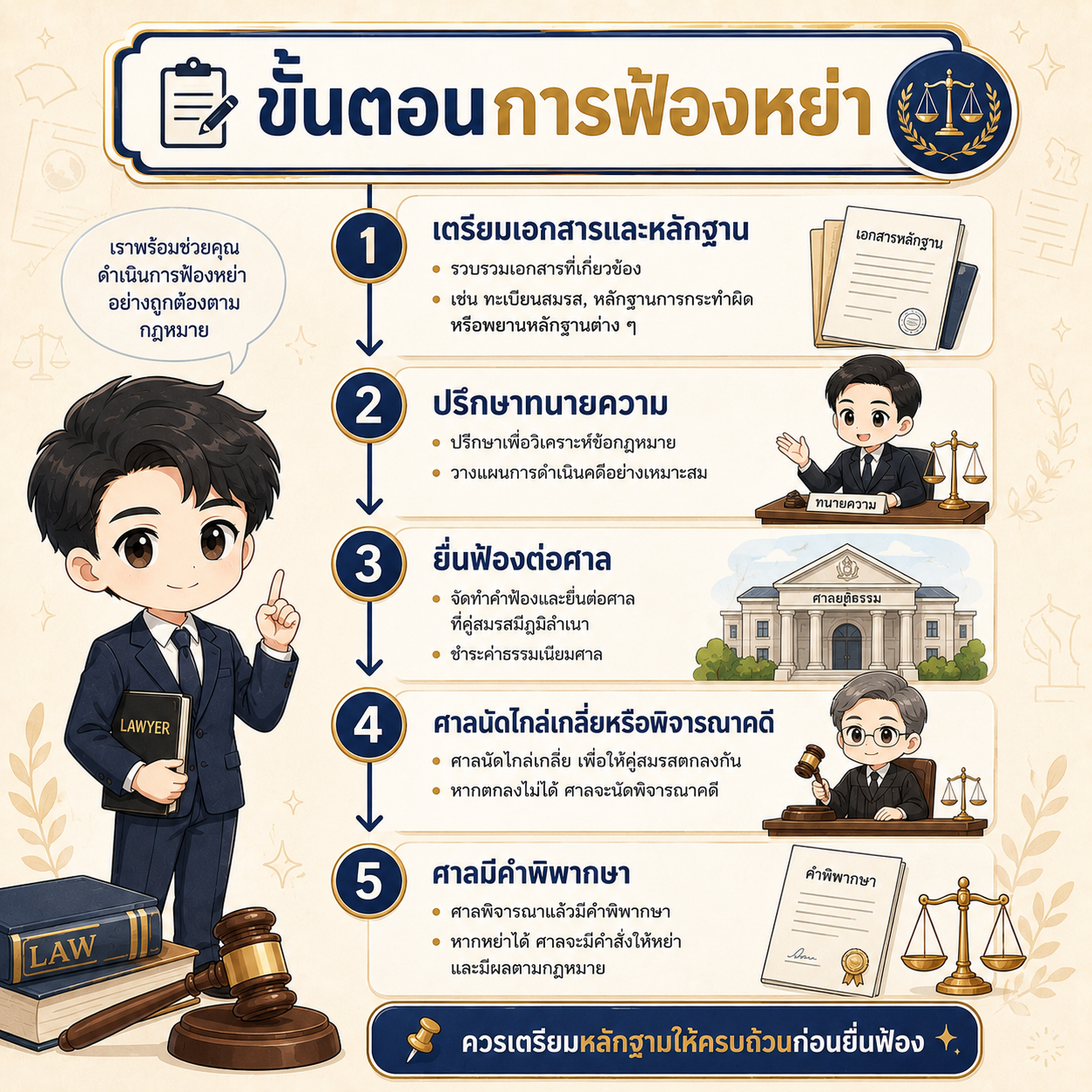
The general steps for filing a divorce case are as follows:
1. Consult a Lawyer and Analyze the Facts
Before filing a case, it is advisable to consult a lawyer to assess whether the facts fall within the legal grounds for divorce, whether there is sufficient evidence, and what claims should be made, such as divorce, parental authority, child support, spousal maintenance, compensation, or division of marital property.
2. Prepare Documents and Evidence
Gather all relevant personal documents, family documents, asset documents, debt documents, income records, and evidence relating to the grounds for divorce. These will be used to prepare the statement of claim.
3. File the Statement of Claim with the Court
Once the statement of claim and supporting documents are ready, the case will be filed with the court that has jurisdiction. In general, family cases fall under the jurisdiction of the Juvenile and Family Court.
4. Court Mediation or Court Proceedings
Family cases often include a mediation process to give the parties an opportunity to reach an agreement on important issues, such as divorce, children, property, or support payments. The website of the Central Juvenile and Family Court also contains a section on family case mediation and materials explaining family case mediation, reflecting that mediation is an important part of family proceedings.
If the parties can reach an agreement, the court may record the agreement and issue a consent judgment. However, if the parties cannot reach an agreement, the court will proceed with the trial, examine witnesses, and render a judgment.
5. Court Judgment
If the court finds that there is a legal ground for divorce and sufficient supporting evidence, the court may grant the divorce. The court may also consider other related issues, such as parental authority, child support, division of marital property, spousal maintenance, or compensation, depending on the claims made by the parties and the evidence presented.
What Issues Does the Court Consider in a Divorce Case?
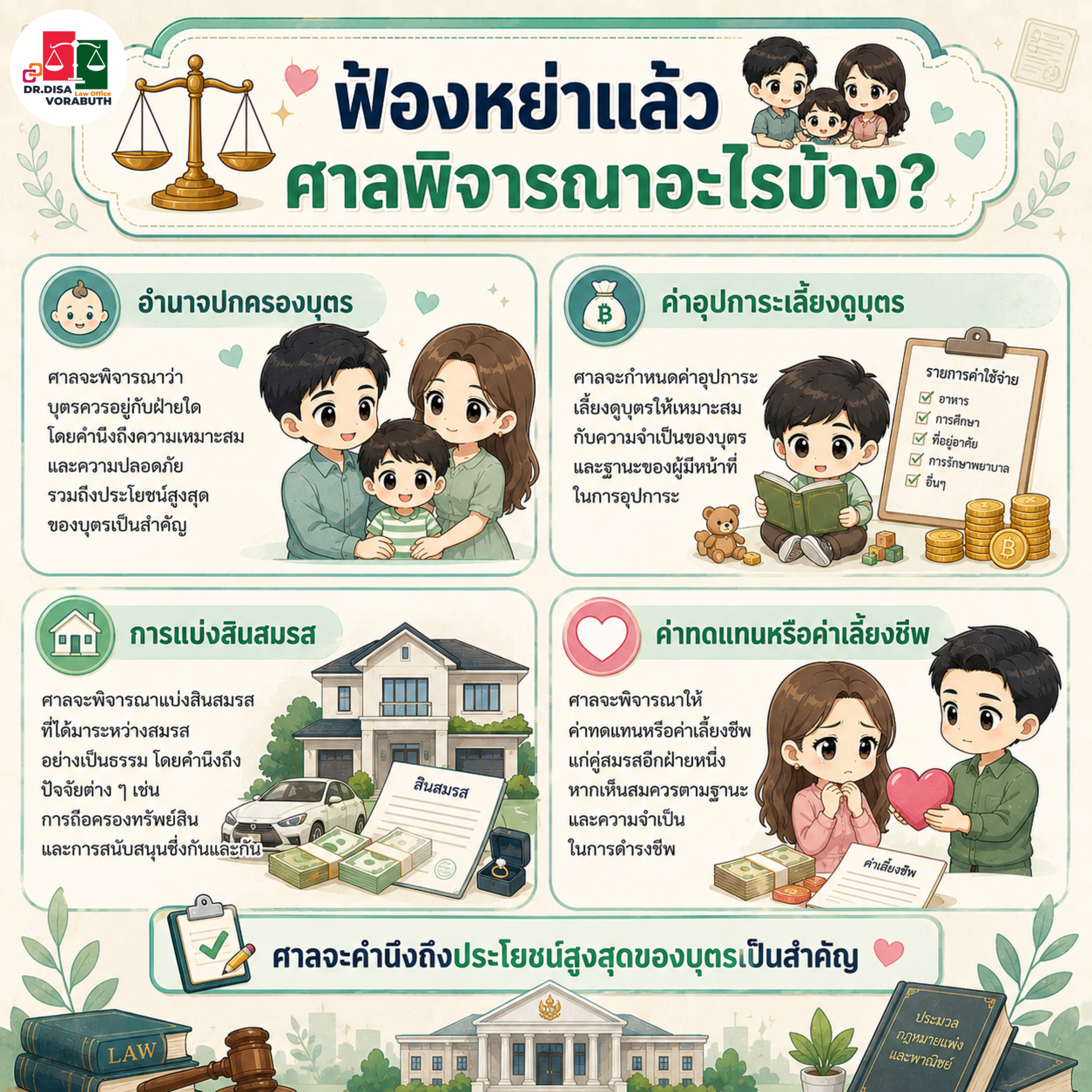
A divorce case does not only involve the question of whether the court should grant a divorce. The court may also need to consider other family-related issues.
1. Parental Authority
If the spouses have children together, the court will consider which parent the child should live with. The court will take into account suitability, safety, living environment, ability to provide care, and, most importantly, the best interests of the child.
Example
Even if one parent has a higher income, the other parent may have been the primary caregiver, have a close relationship with the child, and be able to properly take care of the child’s daily life. In such a case, the court may consider granting that parent primary care of the child.
2. Child Support
The court may order the parent who is not the primary caregiver to pay child support on a monthly basis or in another appropriate form. The court will consider the child’s needs and the financial status of the parent who has the duty to pay.
Expenses that the court may consider include food, school fees, transportation, medical expenses, clothing, and other necessary expenses.
3. Division of Marital Property
Upon divorce, the court may consider the division of marital property, such as houses, cars, bank deposits, shares, or other assets acquired during the marriage. It is important to clearly distinguish between marital property and personal property.
Example
A house purchased after marriage registration and paid for during the marriage may be an issue for the court to consider as marital property, even if the title is registered in only one spouse’s name. On the other hand, property owned before marriage or specifically inherited property may be personal property, depending on the facts and evidence.
4. Spousal Maintenance or Compensation
In some cases, one spouse may be entitled to claim spousal maintenance or compensation, such as where the divorce is caused by the other spouse’s adultery or conduct that causes damage. However, such claims must have a legal basis and be supported by evidence.
 Tel : 062-652-4259 (Attorney Dr. Ning)
 LINE ID : @disavorabuthlaw
 For more information, please follow us on
ด้วยประสบการณ์ด้านกฎหมายที่สั่งสมมาตั้งแต่ปี พ.ศ. 2555 เราคือผู้เชี่ยวชาญที่คุณวางใจได้ในทุกปัญหาทางกฎหมาย ไม่ว่าจะเป็น กฎหมายแพ่งและพาณิชย์ ที่ครอบคลุมสัญญาต่างๆ การฟ้องร้อง และการดำเนินคดี หรือกฎหมายแรงงาน ที่ช่วยให้ธุรกิจของคุณหลีกเลี่ยงข้อพิพาท นอกจากนี้ เรายังเชี่ยวชาญใน กฎหมายครอบครัว กฎหมายมรดก กฎหมายคุ้มครองผู้บริโภค กฎหมายทรัพย์สินทางปัญญา กฎหมายอาญา และกฎหมายอื่นๆ นอกจากนี้ เรายังให้บริการให้คำปรึกษากฎหมายและบริการจดทะเบียนที่ครอบคลุมครบวงจรทั้งในกรุงเทพฯ และนครราชสีมา
ด้วยประสบการณ์ด้านกฎหมายที่สั่งสมมาตั้งแต่ปี พ.ศ. 2555 เราคือผู้เชี่ยวชาญที่คุณวางใจได้ในทุกปัญหาทางกฎหมาย ไม่ว่าจะเป็น กฎหมายแพ่งและพาณิชย์ ที่ครอบคลุมสัญญาต่างๆ การฟ้องร้อง และการดำเนินคดี หรือกฎหมายแรงงาน ที่ช่วยให้ธุรกิจของคุณหลีกเลี่ยงข้อพิพาท นอกจากนี้ เรายังเชี่ยวชาญใน กฎหมายครอบครัว กฎหมายมรดก กฎหมายคุ้มครองผู้บริโภค กฎหมายทรัพย์สินทางปัญญา กฎหมายอาญา และกฎหมายอื่นๆ นอกจากนี้ เรายังให้บริการให้คำปรึกษากฎหมายและบริการจดทะเบียนที่ครอบคลุมครบวงจรทั้งในกรุงเทพฯ และนครราชสีมา